Salting is a line item on every seasonal rate card in this county, adding roughly $400 at the residential tiers. It is also the part of winter maintenance most often bought without anyone explaining its limits.
Work is carried out by an independent snow removal operator under their own company name and insurance. This site arranges the introduction and clears nothing itself.
The Road Commission for Oakland County states it plainly in its own public material: salt begins to lose its effectiveness on paved roads when the temperature drops below 20°F. Public guidance in Michigan puts the practical floor for scattering rock salt at around 15°F. Below that it sits on the pavement doing very little except washing into the storm drain in March.
That threshold is not academic in this county. December through February of 2013–14 averaged 20.9°F — the coldest three-month stretch in 36 years — which is a whole winter spent at or under the point where salt stops earning its price. An operator who applies the same product at the same rate at 28°F and at 12°F is not doing ice control at either temperature.
RCOC also uses sand rather than salt on gravel roads, of which the county has more than 750 miles, because salt does nothing useful on an unpaved surface. If your road or a section of your property is gravel, that is a different product and a different line on the quote.
Michigan’s environmental agency sets the chloride concentration at which aquatic life suffers chronic effects at 150 parts per million, and the acutely toxic level at 320 ppm. Its 2022 Fall Bug Hunt Report documented seven Rouge River test sites at toxic chloride levels.
The Rouge runs 127 miles through Oakland, Washtenaw and Wayne counties. It is not somewhere else. The state has funded chloride sampling at roughly 40 sites along it through Friends of the Rouge, running January through May with test strips, sensors and lab analysis.
Local practice is already moving. Troy operates designated “no salt zones” where natural brine or sand substitutes in environmentally sensitive areas, and uses liquid de-icer applied through an automated system on its salt trucks. MDOT pre-wets rock salt and lowers truck speeds to reduce scatter. Statewide salt use fell 37 percent in the warm 2023–24 winter, which is mostly weather but also a reminder of how much of it is discretionary.
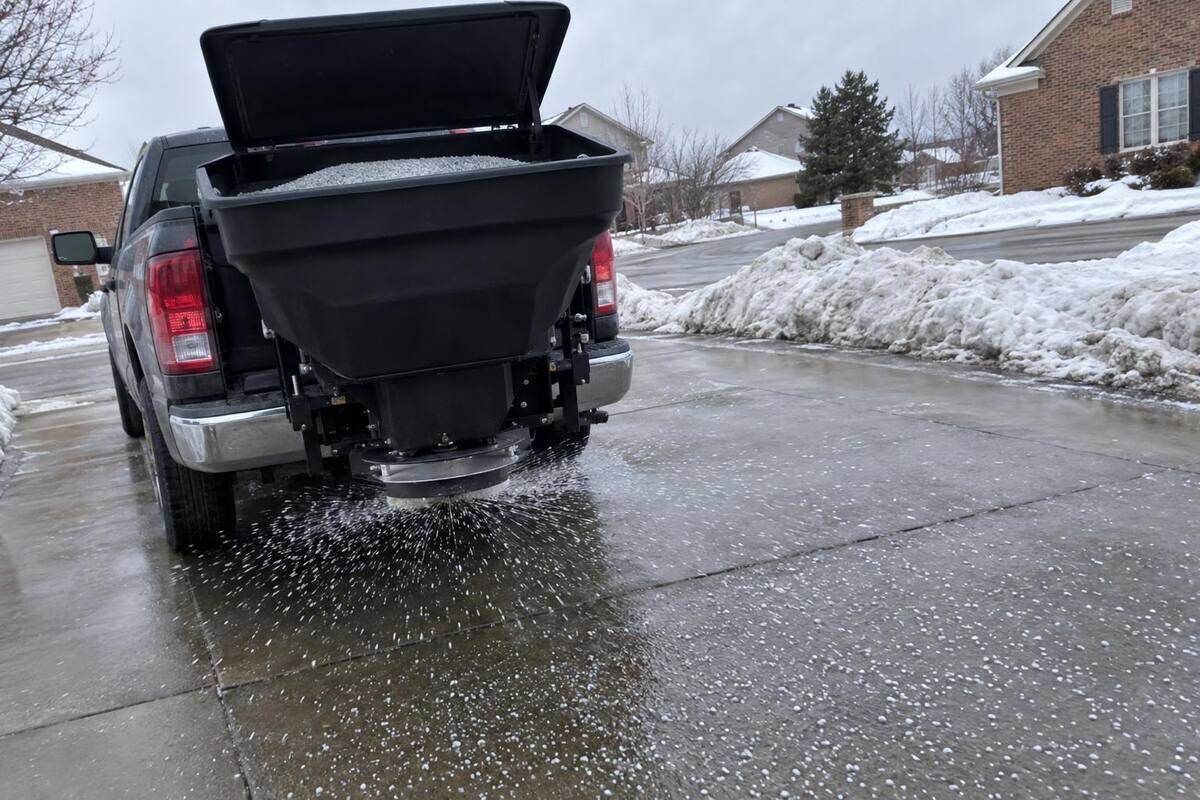
Some states run a certification program for winter maintenance professionals. Michigan does not. There is no state salt applicator credential, no “smart salting” certification, and Michigan’s pesticide applicator license has nothing to do with de-icing. A contractor advertising a Michigan credential of that kind is describing something that does not exist.
What can be asked instead is concrete:
On the published residential rate card in this county, adding salting to a seasonal contract costs roughly $400 at the single and double driveway tiers — $1,595 becomes $1,995 — $700 at the circle-drive tier, and $3,000 on a large estate.
In public-sector contracting it is priced as a separate application rather than bundled: a State of Michigan contract lists rock salt on parking lots and calcium chloride on sidewalks as distinct per-application line items, quoted separately from plowing. That structure is worth asking for on a commercial or association property, because it makes an over-salting habit visible on the invoice instead of hiding it inside a seasonal number.
One market caution, quoted from an operator in this county rather than invented: salt shortages have affected recent seasons, and at least one local contract states that if suppliers run out or prices spike, salting may be skipped. If salting is the part you are buying, ask what happens when supply tightens.
Describe the property in a sentence and the quote comes back as a number rather than a range.
Call (248) 494-7362 Get a Seasonal Quote Oakland County