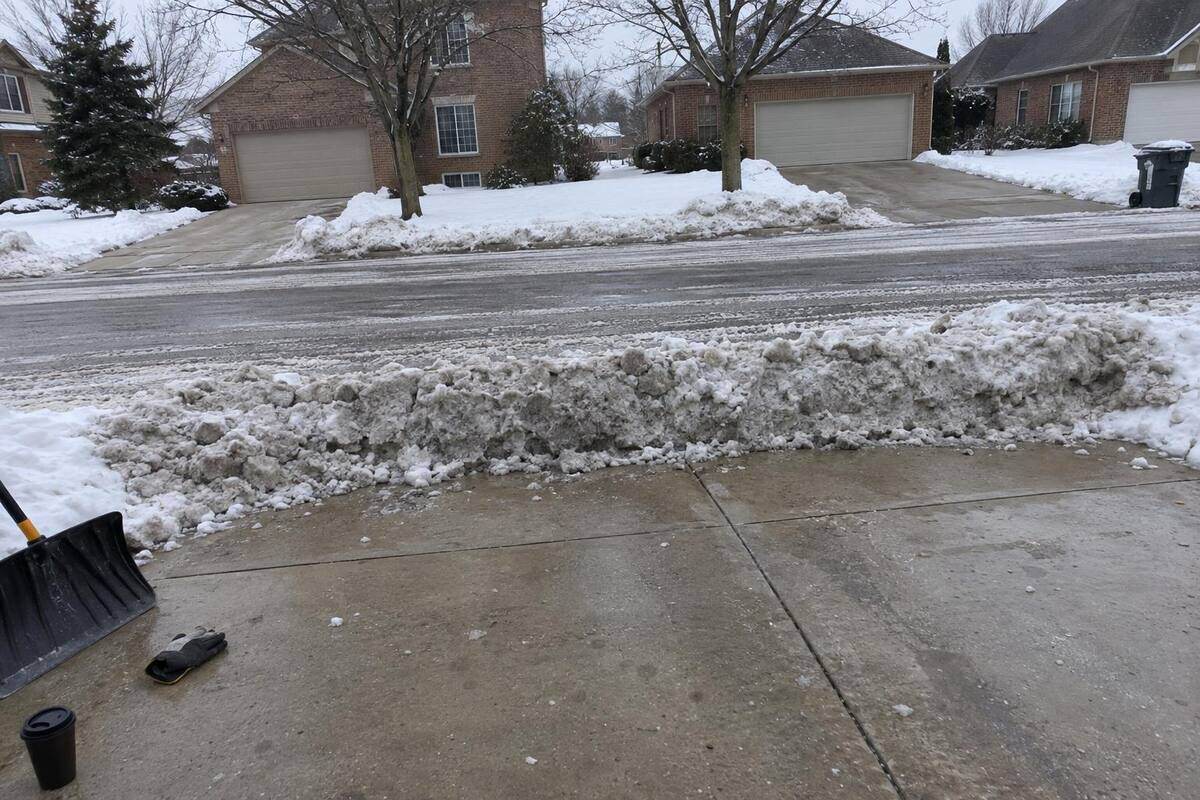
Your driveway can be cleared at 5 a.m. and sealed shut at 9 a.m. by the same municipal truck that finally reached your street. In Oakland County that ridge is the homeowner’s, and the cities say so in writing.
Work is carried out by an independent snow removal operator under their own company name and insurance. This site arranges the introduction and clears nothing itself.
Farmington Hills publishes an entire page on the subject. Its definition: a windrow is “the row of snow left on the side of the street or at the bottom of a driveway after the snowplow has cleared the road.” Its position: “Homeowners are responsible for clearing the windrows formed at the bottom of their driveway.” Its explanation, which is fair: an operator cannot raise and lower the blade at each driveway without leaving snow in the traveled roadway, which is a hazard for everyone using it. The city repeats the point in its storm notices — accumulation at driveway entrances following plowing is inevitable.
Troy is blunter. Property owners “should expect to have windrows of snow encroach” their driveway approaches, and the city states plainly that it does not have “enough hours, staff, money and equipment” to clear them.
Bloomfield Township does not clear snow pushed into driveways either, and goes further by addressing contractors directly: residents are told to direct their snow removal contractor to pile snow far enough off the road to keep the roadway from narrowing, and specifically not to push it onto the left side of a driveway — because the township plow will push it straight back.
Snow that has been carried along a roadway by a plow blade arrives compacted, mixed with road salt and grit, and often partly refrozen. It sits in a dense ridge two to four feet deep against the apron, and it is exactly where a shovel has the least leverage and a snowblower chokes.
It also arrives after the contractor. RCOC works its subdivision streets last by policy — it has more than 1,300 miles of them to reach after 1,400-plus miles of major county road — so on a subdivision street the municipal plow commonly passes hours after the driveway was cleared, and sometimes the following day. A contract with no berm provision is a contract that clears your driveway once, on the operator’s schedule, and leaves the hard part.
The operator comes back after the municipal plow has been through. The most expensive structure, and the only one that solves the problem outright. Ask whether it covers the apron specifically rather than “the driveway,” and how the operator knows the street has been plowed.
Reasonable when disclosed. Get the per-visit figure. At $50 to $100 a time across eight to fifteen events in a season, a berm clause can be worth more than the difference between two quotes.
The default, because almost nobody asks. Some operators absorb it when they are nearby; many do not. Silence in the contract is not a promise.
A related question worth asking at the same time: what happens on a storm that ends at 2 p.m.? The municipal plow may not reach a subdivision street until the small hours, and a contract that guarantees one visit per event will usually count that as done.
Facing the street from your garage, put shoveled and blown snow on the right side of the driveway. The plow travels with its blade angled to cast snow to the operator’s right, toward the curb on its own side of the road — so snow piled downstream of your apron gets carried away from it, while snow piled upstream gets dragged straight back across.
Bloomfield Township publishes this advice to residents and to their contractors, and it costs nothing. It does not eliminate the berm. On a normal storm it meaningfully reduces it.
Describe the property in a sentence and the quote comes back as a number rather than a range.
Call (248) 494-7362 Get a Seasonal Quote Oakland County